
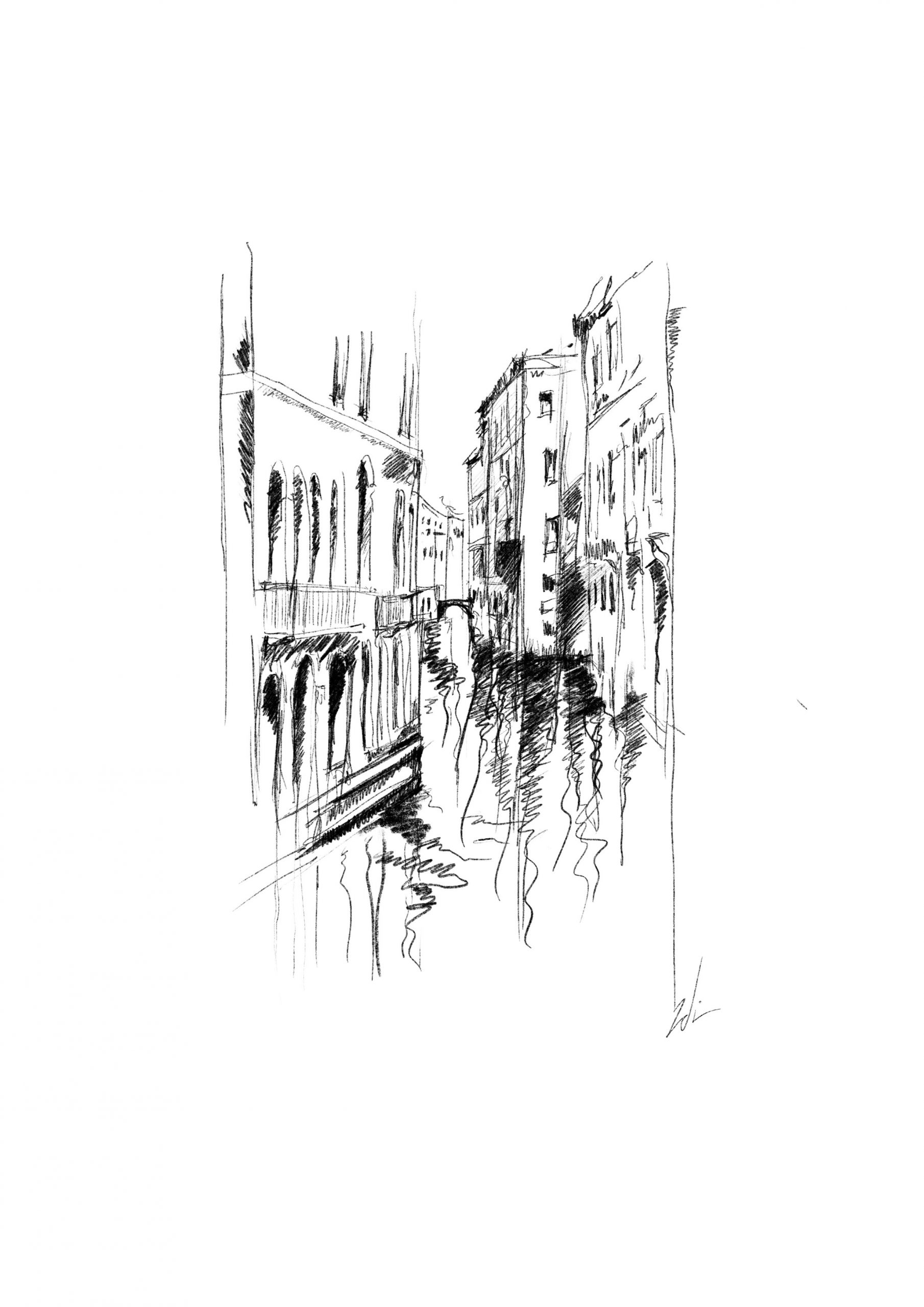
« Venise »
2018
Crayon de papier
210 x 297 mm
VENICE MASKING THE REAL
We would like to start our presentation with the essence, followed by our observations from the week.
So, the workshop emphasized the aspects
mask / decor / structure / play / stage.
We saw that the architectural space, defined by the facades and bodies, can be transformed and overwritten. The filling of the space –the people and their interactions– is what influence us in a positive or negative way. That’s what characterizes the character of a room. The facades and the buildings are only backdrops which, however, influence people again. It’s a game.
Thus, as architects, we should centre the aspects:
real world / culture / people / interaction
Observations
Venice presents itself to the twenty-first century as a palimpsest of memorized looted fragments. The organisation of spectacle and theatricality achieved through an eclectic mixture of style, historical quotation, ornamentation and diversification a perfect stage for the people of today: It’s the common sense of Venice: The participants see themselves in front of the historical decor with the most beautiful facades. They are like on a stage, playing their role, with an attached mask (smiling with a duck-face), the dead bodies in the backdrop, and all this through a screen of a device. A device that spreads the image – following that act – around the world. In places like these, Venice has been affected by a cancer. But the true beauty, however, can be found in the narrow streets, in the schools, in the markets and all the remaining public spaces. In short, wherever cultural values and interaction between people are above economic interest.
Venice masking the real
This collage represents the historical theater of Venice. In this picture we compare it with a section of a theater. The facade is the decor and it becomes a mask for the city behind.
The mask is playing a centurial metaphoric rule in the city. It’s suggests a reality beyond the grasp of casual tourist. Behind the decor, we can find this continuity in the city, independent of the scene.
The body is like the backstage. It’s there where the daily life happens, what makes the play work. Without the body of the principal facade the scene work, because of a theater image.
But who looks at it?
The canal works like a public and urban space. It’s from there that we can admire the decor. That is why we present this picture like that.
Furthermore, we can see that nobody really take a look at the scene, but rather used like a background for selfies.
Nowadays, Venice is been seen through the cameras.